
INDIA’s national animal
A Background –
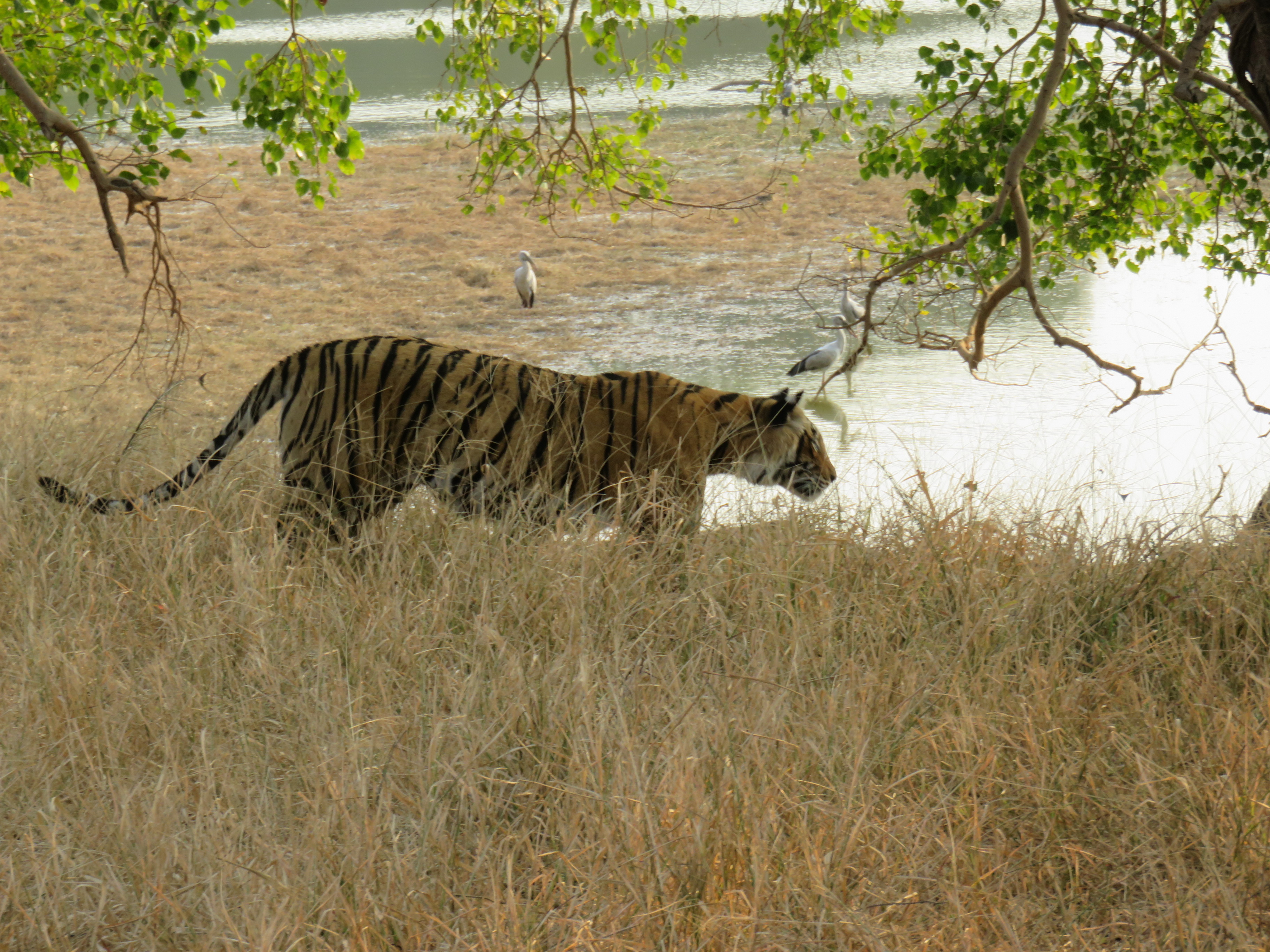
About a hundred years ago, an estimated 58,000 – 100,000 tigers roamed India’s lush, unbroken forests. But centuries of hunting and habitat destruction left fewer than 2,000 wild individuals by the 1970s. In 1973, the government declared the tiger India’s national animal, banned hunting, and set up a conservation scheme called Project Tiger. There are 50 reserves today under the program, and about half are well-managed, according to a government assessment. The reserves are small, averaging less than 1,500 sq. km. — much smaller than many protected areas in Africa. These are unfavorable conditions for the solitary tiger. Male Bengal tigers need a home range of about 60–150 sq. km., whereas females use about 20–60 sq.km. depending on prey density. And tigers do not share easily, even with siblings or kids. So, when a cub hits adolescence at about one and a half years, it begins roaming to find territory in which to live and hunt. If the tiger reserve is already full, tigers don’t have many options. They either push out an old or weak tiger and take over the space or move outside the reserve until it finds unoccupied territory. It is thought that 70–85% of India’s tigers are inside reserves.
Historically, tigers roamed India and 29 other nations, from the Indonesian swamps to the Russian taiga. There were once Balinese, Caspian, and Javanese subspecies, all now considered extinct. Today, only six subspecies remain. IN 2014 the International Union for Conservation of Nature (IUCN) estimated that there are only about 2,200 to 3,200 individuals in the wild. This placed the animal on the world’s endangered species list. About 93% of the tiger’s historic range has emptied owing to habitat loss, poaching, and depletion of prey.
The specter of a world without tigers led 13 nations to meet in 2010 in St. Petersburg, Russia. A declaration was signed, to double wild tiger numbers by 2022 as part of the World Bank’s Global Tiger Initiative (GTI). However, all except India, Nepal, and Bhutan are struggling to save their tigers, even in protected reserves.
Against this backdrop, India is the beacon. It has roughly two-thirds of the world’s tigers in less than one-quarter of its global range. By 2019, India had invested 3.5 billion rupees (US$49.4 million) in tiger conservation, and relocating villages outside protected areas. India has also built the world’s largest animal underpass to funnel tigers safely beneath a highway in central India.
About 3% of the spending on tigers is flowing to government-sponsored science. Government scientists are studying all aspects of the animal. They are heading a large tracking study to understand tiger behavior. Today India has entered the Guinness World Records for the largest camera trap wildlife survey.
The efforts have paid off, according to the government. It announced in July 2021 that the number of wild tigers in the country had doubled from 1,411 in 2006 to2,967 in 2018. India met the St. Petersburg target 4 years ahead of the 2022 target. Indian Prime Minister Narendra Modi declared that tiger conservation could go hand in hand with development plans – adapted from Nature.
The Journey –
Having spent my childhood reading National Geographic, it was a delight to travel across India and Africa. Experiencing wildlife first-hand—and filming it—revealed the profound beauty of the natural world. After nearly two decades in the corporate sphere, these experiences felt especially meaningful. They touched the soul and stirred a desire to respond to the deteriorating conditions on the ground. When I compare my life in the United States and India, the contrast is stark. The U.S. has roughly three times the landmass but only about one-third of India’s population, resulting in a population density nearly ten times lower. This highlights the severe pressure on natural resources in India. With a vast population and a rapidly growing middle class, resource demands are immense. As a result, wildlife today occupies a far smaller land base than it did a century ago.
After my African odyssey, the resolve to support nature and wildlife was strong—but the question remained: where to begin? As a lover of big cats, Africa offered many possibilities. Yet a deeper thought prevailed: why not give back to India? The answer surfaced almost overnight. I recalled a National Geographic article from 1984 on Rajasthan’s tiger reserves, etched vividly in my memory from when I was just twelve years old—the striking images of tigers, some gazing down from fort ramparts as vehicles passed through the forest below. That memory led to a simple thought: why not approach them? I visited the NGO office of the former Field Director featured prominently in that 1984 issue. As he listened to my narrative—my journey, my desire to contribute to conservation, and the fact that nearly twenty-five years had passed since that article—it felt surreal to him. Retired by then, he was clearly impressed, but more than that, I think deeply moved that I had come in a purely individual capacity, intent on making a difference. That was how it all began!! — As the saying goes, all good things start small—and all good things take time. I lived that truth firsthand. I consider myself a patient person, but nothing could have fully prepared me for what this journey demanded. It required far more—in many directions, and all at once—than I had ever imagined or encountered before.
Thereafter, contributing since 2010 as a Goodwill Ambassador to Project Tiger in Rajasthan has been a deeply meaningful endeavor—one that is difficult to fully capture in words. Experiencing the state’s magical landscapes, which many of us grew up seeing in films and later traveling through, alongside its rich culture, heritage, and wildlife, felt like the convergence of many long-held karmic wishes. Born and raised in India, and having worked extensively in the United States, I became increasingly concerned by the condition of rural communities and their surrounding landscapes. This strengthened my resolve to go beyond my professional responsibilities to help address these challenges. Working closely with the state government for the benefit of both communities and wildlife proved to be an extraordinary learning experience—one that significantly reshaped my perspectives and approach to life. At a deeper level, it also evoked a sobering realization: that life has been generous to some, and far less so to many others. These socio-economic divides have plagued humanity for millennia, and have become even more pronounced in the post-industrial era. In much of the developing world, the gap between the haves and the have-nots remains stark. Although this subject lay well outside the bounds of my professional domain, it became clear to me that pathways to addressing these challenges lie within a sustainable rural development paradigm.
In 2005, the Government of India constituted a Tiger Task Force to study the alarming decline in tiger numbers (see Report). One of the task force’s key findings was that increasing human pressure within protected areas was leading to the degradation of natural habitats and the loss of inviolate space, among other impacts. The report strengthened the government’s resolve to address human influx into protected areas through the introduction of a voluntary relocation programme. This took the form of a Centrally Sponsored Scheme (CSS) launched in 2008. Under the scheme, a compensation package of ₹1 million per family (defined as husband, wife, and non-adult children) was provided to support relocation from protected areas to civil or revenue lands. This amount was revised to 1.5 million in 2021. In multi-family rural households, where several families often reside under one roof, the cumulative compensation could be significantly higher, making the relocation financially attractive for many. However, resistance to change—even when beneficial—is a well-known human challenge. In the absence of adequate motivation or practical know-how, many families and communities remained apprehensive about relocation, uncertain about outcomes and impacts. This hesitation was particularly pronounced among older generations, more so than among the younger members of the household.
Undertaking such a relocation exercise is far from trivial, which is why the government sought my support as a goodwill liaison. I agreed—almost instinctively—in 2010. However, once I became involved, the true scale of the challenge became clear. There was a lack of the necessary human resource skills and bandwidth to manage such a complex and sensitive process. Equally important was the need to build trust-based relationships with village communities through sustained and meaningful dialogue to enable this transition. The ground reality was that forest staff and villagers had historically been at odds, largely due to issues of non-compliance around grazing, tree felling, farming practices, access rights, hunting, and other regulations. The importance of “soft skills” in enabling change on the ground was neither adequately acknowledged nor sufficiently provisioned within the Centrally Sponsored Scheme. Instead, the focus remained largely on fiduciary and procedural responsibilities across the revenue and forest departments. It took our team weeks, months, and eventually years (a decade) to help bring about change. This involved continuous engagement with village communities—listening to their concerns, understanding their challenges, and clearly explaining what life outside forest areas could offer. We spoke about improved access to education for children, better healthcare, and basic services such as electricity and water, all of which could contribute to a better quality of life. At the same time, I was deeply exposed to their way of life—primal, sustainable, and culturally rich in ways modern systems often overlook. While I had stepped in to support them, the experience ended up transforming me in ways I could never have imagined. It taught me to let go of worldly anxieties, to slow down, to breathe more deeply, and to reconnect with the natural rhythms and systems we are inherently meant to live within—far removed from the relentless pace of the rat race. Most importantly, because all of this unfolded organically and without expectation, it has been a true blessing!!
I began by contributing approximately a week of my time each month to this effort, serving in an advisory and catalytic role. The rigorous and steadfast follow-up by the ground staff has since enabled the relocation of nearly 1,300 families—over 6,000 individuals in total under the CSS, with a capital expenditure of approximately USD 25 million, in addition to operational costs covered under the forest and revenue department budgets. Today, I say with humility that my association with these communities since 2010 and the government’s teamwork has contributed to more than doubling the state’s tiger population. It has also helped add approximately 200+ square kilometers of inviolate space to the national park. Rajastan then added new Tiger reserves as well. These outcomes are, above all, the result of the tireless efforts of the forest staff and the willing cooperation of the village communities. This collective teamwork was recognized with the RBS-BNHS 2012 Protect the Species Award in the lead-up to the 2012 UN Convention on Biological Diversity’s (CBD) COP11 in Hyderabad.
Additionally, my role included outreach to both state and central ministers to address challenges that could not be resolved through standard government channels. Over time, we were able to engage NGOs to work directly with communities, supporting their development and well-being. While much progress was made, I realized that far more remained to be done. Below is a list of some official communications from that period:
- ↓ May 2011 to MoEF Mr. JaiRam Ramesh,
- ↓ December 2012 to CM Mr. Ashok Gehlot,
- ↓ March 2013 to Chief Wildlife Warden Rajasthan,
- ↓ February 2014 to CM Smt. Vasundhara Raje,
- ↓ August 2014 to CM Smt. Vasundhara Raje,
- ↓ March 2016 to CM Smt. Vasundhara Raje,
- ↓ February 2020 to CM Mr. Ashok Gehlot,
The joy of contributing to this work, and the delight of each day spent with the communities, has been deeply enriching—more than any profession could ever offer—due to exposure to so many interconnected disciplines. I am truly thankful for the opportunity and humbled by the generosity and resilience of these simple, hardworking rural communities. They own so little and work so hard, yet often seem far happier than many city dwellers who have far more.
After these experiences, I felt strongly that rural communities and their landscapes could achieve much more. Larger, coordinated initiatives are needed to support community livelihoods—efforts that help preserve value systems, skills, arts, culture, and heritage, while also restoring wellness to the landscapes themselves. If we can enable such progress and enrich these landscapes, we would go a long way toward achieving the UN’s Sustainable Development Goals.
Landscape management is key to having everything better, ensuring that communities prosper, and biodiversity thrives – healthy landscapes, ecosystems, and human populations are inextricably linked. The Network for Conserving Central India was convened to help connect science, biodiversity, and sustainability. During a conversation in 2014 with John Seidensticker, his experiences closely echoed my own thinking. The broader perspective he articulated—captured powerfully in his opening address at the Kanha–Pench Landscape Symposium—further strengthened my resolve to help build policies that enable better landscape management. Such policies, in turn, can directly support communities, biodiversity, and the landscapes they depend on.
The successes achieved on the ground throughout this journey often left me wishing for more—envisioning what it would take to replicate similar outcomes across Project Tiger landscapes in different states of India. If robust operational models can be developed, they could be applied uniformly across multiple landscapes. Coming from a background of managing large IT organizations, combined with prior exposure to advocacy and policy reform on Capitol Hill in the U.S., my thinking naturally began to connect the dots. What is needed are holistic solutions in the landscape management and sustainability space. Creating livelihoods for communities within the green economy, increasing green cover, and meaningfully involving the private sector are all essential to achieving scale. These elements must be provisioned upfront and then actioned through sound policy frameworks operating across multiple levels—from national to territorial governments. If this can be done in a way that prioritizes community needs and human well-being first, the resulting benefits to landscapes and biodiversity—what one might call landscape wellness—will follow. This places strong emphasis on a bottom-up strategy, which can then align with and complement traditional top-down, sectoral outlays within our institutional systems to achieve sustainability at scale. This approach and strategy represent the next major step—one that remains to be fully developed and systematized if we are to achieve sustainability goals that have thus far eluded us. More on this under the G.A.L.L.O.P. initiative, aimed at building back better in a post–COVID-19 world. The outcomes remain to be seen.
There’s good news in 2026 on tigers in India and a happy problem to solve going forward—read the article in the Times of India.
CREDITS:
- Shekhar Dattatri’s Truth About Tigers Film – Vimeo, YouTube
- The United Nation’s – 2011 Year of the Forests video release
- The World Bank’s Global Tiger Recovery Program 2012-2022 report
- The Earth-Policy Institute’s Presentation & Book




 Bhushan H. Sethi